
Leadership Training Grounded in Psychology, Ethics, and Human Behavior

I provide psychology-informed leadership training for professionals who make high-stakes decisions under pressure, navigate ethical complexity, and lead teams through stress and change. This work is educational and consultative. It is not therapy.
Licensed Clinical Psychologist, CA & VA | Certified Clinical Trauma Professional (CCTP-II) | ACT-Informed Leadership Training
Dr. Sheila Vidal is a licensed clinical psychologist in California and Virginia and the founder of Next Mission Recovery. She provides psychology-informed leadership training on ethical decision-making, psychological flexibility, values-based action, and leading through organizational change. Her speaking and training work is non-clinical and educational, drawing from ACT, trauma-informed principles, and her clinical background in trauma, PTSD, moral injury, anxiety, and high-responsibility professional stress.
Format: In-person and virtual presentations; custom workshops and trainings
Audience: Public safety and code enforcement leaders, supervisors and managers, professional associations, first responder and veteran-serving organizations, healthcare and government professionals
Core Topics: Ethical leadership under pressure, psychological flexibility, values-based decision-making, leading through change, burnout and self-regulation, inclusive leadership, servant leadership, communication during uncertainty
Training Lens: Acceptance and Commitment Therapy (ACT), trauma-informed principles, nervous system awareness, non-violent communication, SCARF model, values clarification
Therapy Boundary: Leadership trainings are educational. They are not therapy. Therapy services are available only to adults in California or Virginia
Consultation Boundary: Strategic psychological consultation may be available for professionals outside California and Virginia when it is non-clinical, non-diagnostic, and not therapy
Location Availability: Presentations available nationally and virtually. In-person availability includes the Sacramento and Folsom, CA area

How I Approach Leadership Training
Leadership is not only about strategy and skill. It is about behavior under pressure. Leaders make consequential decisions when time is short, information is incomplete, emotions are activated, and the stakes are real. Most leadership breakdowns do not happen because someone lacked the right framework. They happen because that person could not access their values when it mattered most.
My approach draws from clinical psychology, Acceptance and Commitment Therapy (ACT), trauma-informed principles, and research on the nervous system and human behavior under stress. ACT is an evidence-based psychological framework that teaches people to clarify their values, increase psychological flexibility, and take committed action even when internal discomfort is high. In leadership, that translates directly. A leader who can name what they stand for, tolerate ambiguity without collapsing into avoidance or rigidity, and act in alignment with their values even when it is costly is a leader their team can trust.
I also incorporate nervous system awareness and the SCARF model (status, certainty, autonomy, relatedness, fairness) to help leaders understand how threat and reward states affect decision-making and team dynamics. Understanding that most conflict and resistance has a neurological component does not excuse poor behavior. It gives leaders a more accurate map of what they are actually managing.
Values do not remove difficulty. They orient behavior when the path forward is unclear. That is the core premise of everything I teach.
Speaking Topics
I design presentations and trainings around the real challenges leaders face, not theoretical management concepts. Topics I address include:
Ethical leadership under pressure and in moral gray areas. Values-based decision-making and values clarification using ACT. Psychological flexibility for leaders, including how to act with integrity when emotions are high and uncertainty is unavoidable. Inclusive leadership and psychological safety for teams. Servant leadership, accountability, and how to hold standards without shame-based management. Leading through organizational change, restructuring, and evolving expectations. Burnout and self-regulation in high-responsibility roles. Communication skills during conflict, uncertainty, and high-stakes moments. Supporting teams through stress, transition, and ethical complexity. Trauma-informed leadership principles, including how unaddressed stress and moral injury affect team culture and retention.
All topics can be tailored to specific professional settings, organizational contexts, and audience needs.
Featured Upcoming Presentation
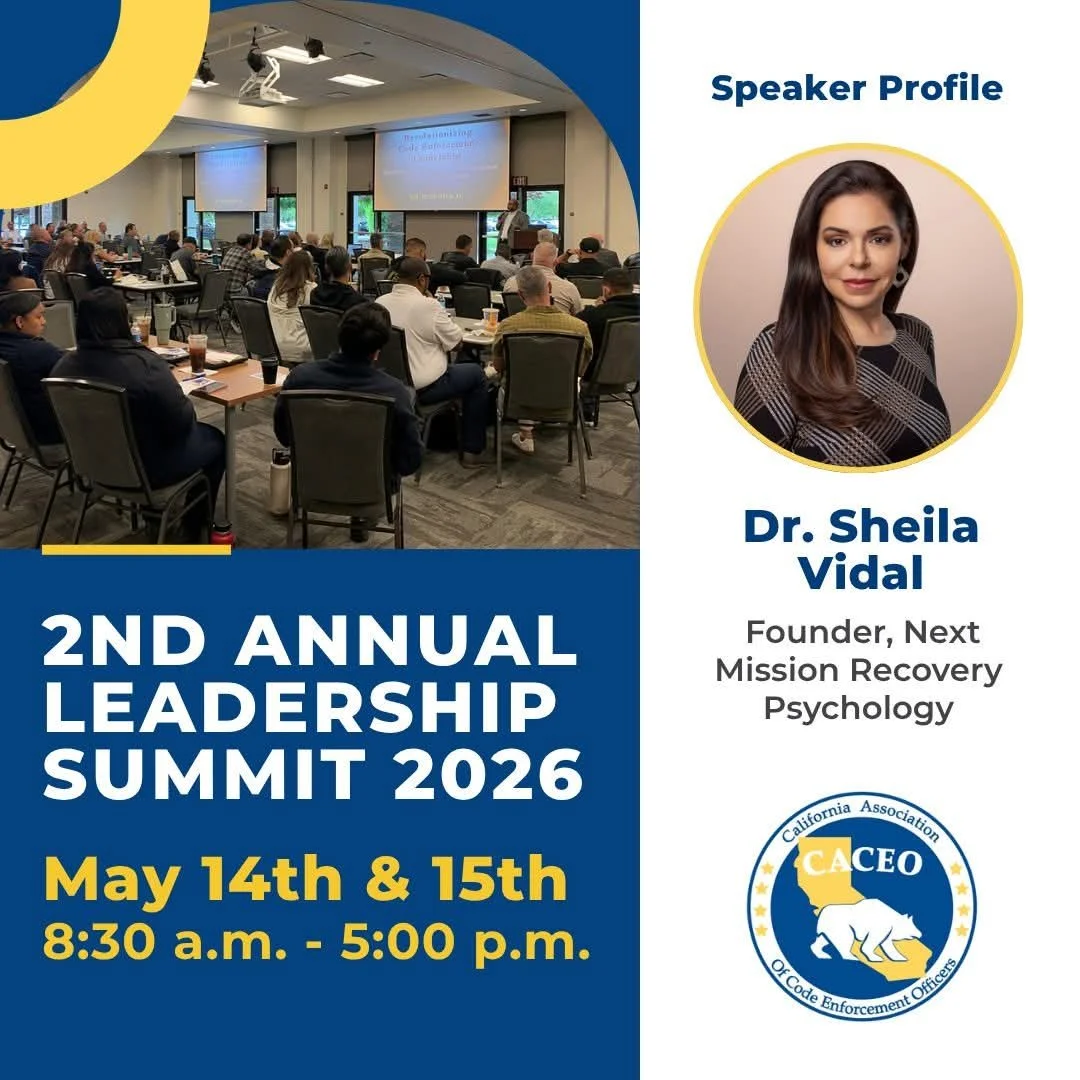
I will be presenting at CACEO's 2nd Annual Leadership Summit 2026 in Elk Grove, California on May 14 and 15, 2026. Elk Grove is just minutes from Folsom, where I also offer limited in-person sessions, and is at the heart of the Sacramento region I serve.
This is a two-day educational summit for CACEO members focused on leadership development in code enforcement. I am presenting two 90-minute sessions:
Ethical, Inclusive, and Servant Leadership This session addresses how leaders foster trust, fairness, and equity while navigating moral gray areas, supporting diverse teams, and maintaining accountability without shame-based management. We explore how values clarification, psychological flexibility, and servant leadership principles translate into daily practice for supervisors and managers in high-stakes environments.
Leading Through Challenges and Change This session equips leaders with practical strategies to adapt, stay resilient, and lead their teams through conflict, stress, evolving expectations, and organizational change. Topics include nervous system awareness in leadership, co-regulation, the SCARF model, and how values-guided action supports team trust during uncertainty.
Signature Presentation Areas
The following are core presentations I offer for professional associations, organizations, and leadership development programs.
Ethical Leadership Under Pressure Ethical decisions are rarely clear-cut. This presentation explores how leaders can use values clarification to navigate moral gray areas, maintain accountability under pressure, and build cultures where ethical behavior is the norm rather than the exception. Participants leave with a practical framework for identifying their values and using them as a compass when the path is unclear.
Leading Through Change Without Losing Trust Change activates stress, uncertainty, and threat responses in teams. This presentation helps leaders understand what their teams are actually experiencing during organizational change, how to communicate during uncertainty without undermining trust, and how to hold the line on expectations while remaining responsive to human needs. Grounded in nervous system science and the SCARF model.
Psychological Flexibility for Leaders Psychological flexibility is the ability to stay present, act in alignment with your values, and move forward even when internal discomfort is high. This presentation introduces ACT-based tools for leaders who want to lead with steadiness rather than rigidity or avoidance, especially during high-stakes moments where habitual reactivity is costly.
Inclusive Leadership as a Daily Practice Inclusive leadership is not a checkbox. It is a set of daily behaviors that either build psychological safety or erode it. This presentation focuses on how leaders can develop practical awareness of the ways their behavior affects belonging, voice, and team performance, with specific tools for self-reflection, feedback, and consistent application.
Values-Based Communication During Conflict Conflict is not a sign that something has gone wrong. It is often a sign that something important is at stake. This presentation teaches leaders how to communicate during high-tension situations in a way that is honest, direct, and values-aligned without escalating or shutting down. Built on ACT-based communication principles and trauma-informed listening skills.

Who This Is For
My leadership training work is designed for professionals in environments where the stakes are high, the decisions are complex, and the human cost of poor leadership is real.
I present for professional associations in public safety, code enforcement, and related fields. I also present for supervisors and managers navigating the transition from individual contributor to people leader, first responder and veteran-serving organizations, and professionals in healthcare, government, and other high-responsibility settings. These trainings may also support teams navigating stress, change, conflict, ethical complexity, or evolving community expectations.
My leadership work is psychoeducational and consultative, not organizational psychology consultation, executive coaching, HR guidance, or legal advice.
Values-Based Leadership Reflection Worksheet
I created a one-page Values-Based Leadership Reflection Worksheet as a companion to my presentations. It is designed as a practical, private reflection tool for leaders who want to apply the ideas from my sessions to their own work and teams.
The worksheet includes:
A prompt to identify three values that guide how you lead. A reflection on what you tend to avoid or default to when pressure is high. A question about what your team may need from you during uncertainty. A brief SCARF self-check covering status, certainty, autonomy, relatedness, and fairness. One values-guided action you can take this week.
This worksheet is not a clinical tool. It is an educational resource for professional reflection.
Leadership Training, Consultation, and Therapy Are Different
I want to be clear about what this work is and what it is not, because that clarity serves you.
Leadership trainings and presentations are educational and consultative. When I present at a conference or lead a workshop, I am a psychologist providing psychoeducation grounded in research. I am not providing therapy. I am not providing clinical supervision. I am not providing legal advice or HR guidance. I am not functioning as an organizational psychologist. These are distinct professional roles with different scope and accountability structures.
Strategic psychological consultation is a separate non-clinical service I offer to individuals and professionals seeking objective, insight-driven guidance. It is advisory in nature, does not produce a clinical record, and is not therapy.
Therapy is a clinical service available only to adults located in California or Virginia at the time of service. If you are attending one of my trainings and find that what we discuss resonates with something you are personally navigating, and you are located in California or Virginia, I encourage you to visit my therapy services page for information about how to get started.
If you are outside California and Virginia and are interested in non-clinical consultation for yourself or your organization, strategic psychological consultation may be an appropriate fit.
Invite Me to Speak or Consult
If you are planning a leadership development event, professional summit, or organizational training and want to explore whether my work is a fit, I welcome the conversation.
Frequently Asked Questions
-
Yes. I provide psychology-informed leadership training and professional psychoeducation for professional associations, public sector organizations, supervisors and managers, first responder and veteran-serving groups, and teams in healthcare, government, and high-responsibility settings. Presentations can be delivered in person or virtually and can be tailored to your organization's context and needs.
-
My presentations address ethical leadership under pressure, values-based decision-making, psychological flexibility for leaders, inclusive leadership and psychological safety, servant leadership and accountability, leading through organizational change, burnout and self-regulation, communication during conflict and uncertainty, and trauma-informed leadership principles. Topics can be customized for your audience.
-
No. Leadership training is educational and consultative. When I present or facilitate a workshop, I am providing psychoeducation grounded in research. I am not providing therapy, clinical supervision, HR guidance, legal advice, or organizational psychology consultation. Therapy is a separate clinical service available only to adults located in California or Virginia at the time of service.
-
Yes. I design presentations around the specific needs, professional context, and learning goals of each organization or event. If you have a defined topic, a specific challenge your team is navigating, or a general area of interest, I can work with you to develop a session that fits your audience.
-
Yes. I offer virtual presentations and trainings via secure video. In-person availability is concentrated in the Sacramento and Folsom, California area, with other in-person engagements considered on a case-by-case basis.
-
Attending a training does not establish a therapy relationship. Therapy is a separate clinical service available only to adults located in California or Virginia at the time of service. If you are in California or Virginia and are interested in therapy, you are welcome to visit my services page to learn more. If you are outside those states and are looking for non-clinical guidance, strategic psychological consultation may be a better fit.
-
Yes. Strategic psychological consultation is a separate non-clinical service available nationwide and in some cases internationally. It provides objective, insight-driven guidance for complex decisions, ethical dilemmas, and high-stakes personal or professional challenges. It is not therapy, does not produce a clinical record, and does not involve diagnosis.
-
Yes. My training work is well suited for public sector and high-responsibility professionals. My clinical background includes work with trauma, moral injury, burnout, anxiety, veterans, first responders, and professionals whose roles require privacy, judgment, and steadiness under pressure. That background shapes how I approach leadership education, especially around stress, values, ethics, communication, and trust.